

On View June 27 - July 29, 2026
Opening Reception Sunday, June 28, 1-4 pm
Moritz Kellerman was born in Nicaragua and received a Bachelor's degree in Art History from the University of Washington in 1981. He continued his education in painting and drawing at Corpus Christi State University and later went on to receive a Master of Fine Arts in painting and drawing from the School of the Art Institute of Chicago in 1988. As a graduate student at the School of the Art Institute of Chicago, Kellerman was inspired by the work of the 20th-century artists Willem de Kooning and Richard Diebenkorn. That influence can be seen in his earlier works. Kellerman is also inspired by the work of the Old Renaissance Masters, and that influence is a big part of his painting process today.
Since 1981, he has exhibited at a wide range of college campuses, museums, and galleries, in both solo and group shows. His works are included in numerous public and private collections nationwide. As a tenured full-time professor, Kellerman teaches Studio Art and Art History at Oakton College.
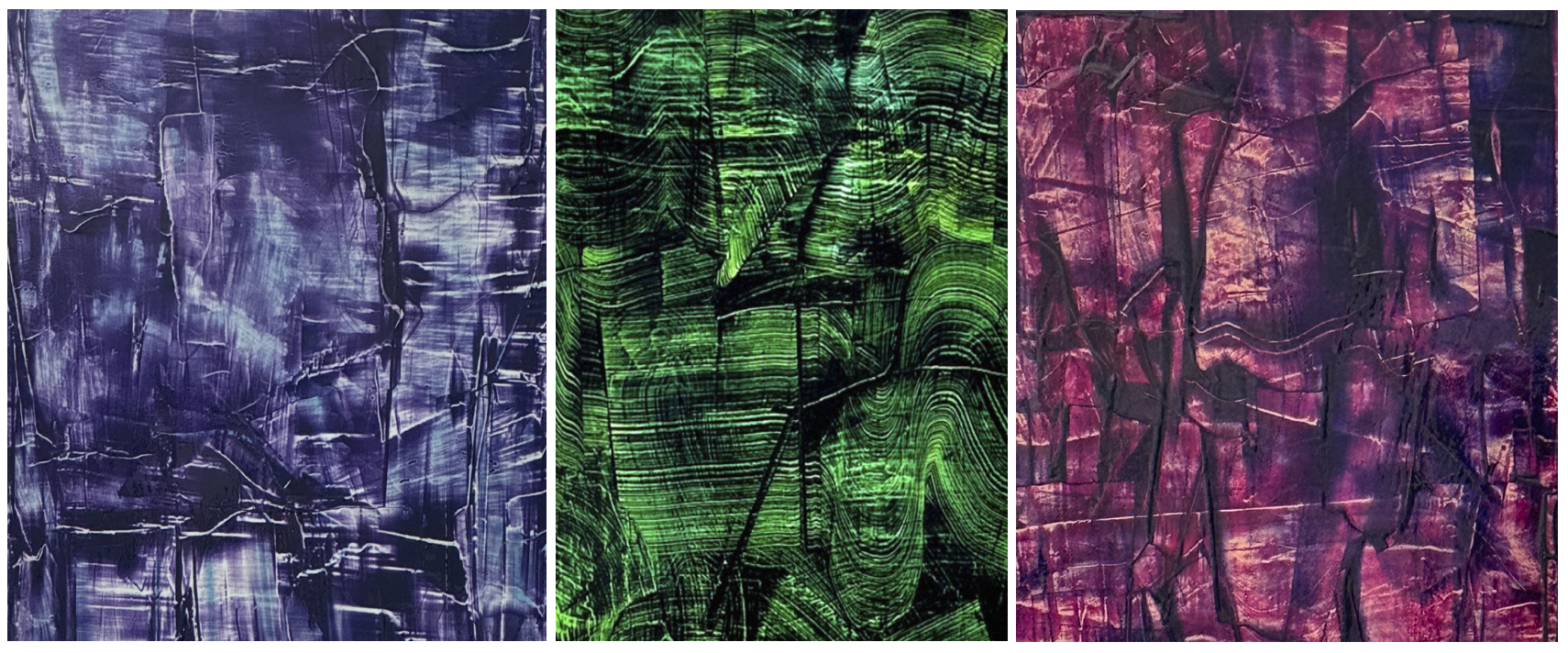
Ever since I can remember, I have been enamored with the work of the Italian Renaissance and their technique of oil painting: glazing. I do my very best to make the most beautiful abstract paintings I possibly can create by connecting my present to the history of the Old Masters with the glazing technique. My use of wood panels hearkens back to the Old Masters as well. The majority, such as DaVinci, used wood panels, and even when linen became available, they glued linen to wood. My work is about color, but my use of color is different from that of other painters. I mix paint on the surface, as Monet did. Instead of mixing colors and letting them speak side by side, I paint in multiple layers. Multiple, microscopically thin layers of paint and medium, and the resulting color and transparency reveal each painting’s own history. Layers can be opaque, transparent, or semi-transparent, depending on the amount of medium. Light penetrates all the way to the first layer. Every pigment has its own characteristics. A hint of the first color is revealed in a scar. It’s like dancing, going back and forth, and back and forth. Each individual painting has its own history that speaks for itself. I’m very happy that I can make them do that. The space and the process are very spiritual. I connect with the divine when I am painting in my studio.
As an artist of the 21st Century and an art historian, I am submerged in the art world of the past and the present. I have learned to reference the past in the present, and some of my paintings have titles that reference the Old Masters. Not all of them, but some! When I started to teach, nobody wanted me to teach drawing and painting; instead, I got plenty of offers to teach art history. And I do have a degree in art history. I wanted to teach studio art instead of art history, but the latter influenced my work in ways that I could not have predicted. I was afraid that one day, I would have to choose one over the other. My job at Oakton College made that fear go away, because they were looking for someone fluent in both fields. That was one of the greatest opportunities of my life. I have been teaching for nearly 40 years, and it has taken many years to reach the point where I feel very good about my paintings. On and off, I think about the time when I will have to retire, but given my passion for teaching and showing my work as a professional artist, I sincerely think that no such thing will happen.
My paintings are a history of complex layers. Do viewers see only the surface colors, or are they able to see deeper into the layers? Will they see the individual layers that lead to the seen surface? This complexity of layers is created slowly over time by the use of the glazing process. This process is my direct connection to my heroes of the past, the Renaissance Masters. I never begin a work with an end in mind. I allow for the creation process to reveal its own story. Every application of paint and medium, each painting's multiple semi-transparent layers of color, work together to form the painting's individual and particular history. As an artist, I enjoy the challenge of manipulating the spectrum of colors to create beauty. As an educator, I continue to strive to equip my students to delve into their own explorations of color and creation.
-Moritz Kellerman
GALLERY HOURS & VISITOR INFORMATION
This exhibition will be held in the Second Floor Gallery of the Evanston Art Center (EAC). Masks are optional but strongly recommended for students, visitors, and staff.
Gallery Hours
Monday–Thursday: 9am–6pm
Friday: 9am–5pm
Saturday–Sunday: 9am–4pm
HOW TO PURCHASE ARTWORK
Artwork sale proceeds benefit both the artist and the Evanston Art Center. If you are interested in purchasing artwork on display, please contact Emma Rose Gudewicz, Director of Development and Exhibitions, at [email protected] or (847) 475-5300 x 102.
This program is partially supported by a grant from the Illinois Arts Council through federal funds provided by the National Endowment for the Arts.
Image Credits: Moritz Kellerman